
What a Legal Deposition Interpreter Must Do
A legal deposition interpreter protects accurate testimony, confidentiality, and due process across languages. Learn what deposition support requires.
Read more
A contract can look straightforward until one defined term changes the obligation of an entire clause. When learning how to translate legal contracts, the goal is not to replace words from one language with another. It is to preserve legal effect, commercial intent, formatting, and the relationships between every defined term, cross-reference, deadline, and signature block.
That standard matters whether you are preparing a bilingual employment agreement, a vendor contract for an international supplier, a lease for a relocating family, or documents for litigation and immigration matters. A missed “shall,” an inconsistent defined term, or a clause translated for the wrong legal system can create confusion long after the document has been signed.
Before translation begins, identify what the document is meant to do, who will use it, and which jurisdiction governs it. A purchase agreement governed by Connecticut law, for example, may contain concepts that do not have a direct equivalent in the law of the target-language country. The translator must communicate the original meaning without silently rewriting the parties’ rights or obligations.
Ask whether the translated contract will be used for internal understanding, negotiation, execution, a government filing, court proceedings, or compliance review. The required level of formality, certification, layout preservation, and review can differ significantly. A bilingual contract intended for signature may need careful side-by-side alignment. A translation submitted as evidence may require a signed certification of accuracy.
Jurisdiction also affects terminology. “Consideration,” “indemnification,” “force majeure,” “without prejudice,” and “best efforts” carry legal and practical implications that vary by system. A translator should research the clause in context and, where necessary, use a precise functional equivalent rather than a tempting word-for-word match.
Reliable legal contract translation begins with a complete source file. Provide all schedules, exhibits, amendments, referenced policies, and prior versions that affect interpretation. A missing attachment can make a cross-reference impossible to verify, while an outdated amendment can produce contradictory language.
The translation team should first identify the document type, governing law, target audience, requested turnaround, and any certification requirement. They should also establish a terminology list for party names, corporate entities, product names, addresses, defined terms, and recurring legal phrases. This preparation prevents a common and expensive problem: translating the same defined term differently in separate sections.
A controlled workflow generally includes translation by a native-speaking legal linguist, independent editing by a second qualified reviewer, and final quality assurance. The final check compares the translation against the source for omissions, numbers, dates, clause numbering, references, names, and formatting. For high-stakes matters, a bilingual attorney or legal professional may also review legal strategy and jurisdiction-specific implications.
The distinction is essential. A professional translator preserves and communicates the source text. A lawyer advises whether the terms protect a client’s interests, comply with local law, or should be revised. Translation is not a substitute for legal advice.
Defined terms are the operating system of a contract. If “Services” is capitalized and defined in Section 1, every later use of “Services” must be handled consistently. The same applies to “Affiliate,” “Confidential Information,” “Effective Date,” and other terms that may look ordinary but have a specific contractual meaning.
Create a bilingual glossary before or during the first pass. Record the preferred translation, context, grammatical form, and any notes about whether the term must remain capitalized. Translation memory tools can support consistency across long agreements and related documents, but they do not replace human judgment. A repeated phrase may require a different rendering when its role changes within a sentence.
Literal translation is sometimes appropriate, especially for clearly defined technical requirements, addresses, names, and standard notices. It becomes risky when a literal version sounds natural but loses the legal function of the original.
Consider modal verbs. In many contracts, “shall” indicates a mandatory duty, while “may” grants permission or discretion. Rendering both with the same target-language construction can change who must act and when. Similarly, “including” may be intended as illustrative rather than exhaustive, and phrases such as “subject to,” “provided that,” and “notwithstanding” establish conditions and priorities between clauses.
Sentence structure deserves close attention too. English legal drafting often uses long sentences with several embedded conditions. Splitting a sentence can improve readability in the target language, but only if the logical order remains intact. The translator must preserve exceptions, triggers, deadlines, and the scope of each modifier.
Do not simplify language merely because it is difficult. If the source contract is ambiguous, the translation should not invent clarity. Flag the ambiguity for the client or legal counsel rather than choosing an interpretation that the original does not support.
Many contract disputes turn on details that are easy to overlook during translation. Confirm every currency amount, percentage, date, notice period, measurement, invoice number, governing-law reference, and exhibit title. Be especially careful with date formats. In a US contract, 04/05/2026 may be understood as April 5, while other audiences may read it as May 4. Spelling out critical dates can reduce avoidable uncertainty when the client permits it.
The layout should also make the translated document easy to compare with the original. Preserve headings, article numbers, page numbering, tables, signature blocks, stamps, and exhibits whenever possible. If the source contains handwritten notes, illegible text, seals, or missing pages, identify those facts rather than guessing.
For bilingual contracts, consistent alignment is more than a design preference. It helps legal teams locate corresponding provisions during negotiation, review, and future disputes. It also reduces the risk that an edit in one language is not reflected in the other.
“Certified translation” can mean different things depending on the receiving organization. In the United States, it commonly refers to a translation accompanied by a signed statement attesting that it is complete and accurate to the best of the translator’s knowledge and ability. Some courts, agencies, and foreign authorities have additional requirements, including notarization or specific formatting.
Confirm the requirement before the work starts. A certification that is acceptable for an immigration filing may not meet a court’s local rule or an overseas authority’s document legalization process. Asking early avoids rushed rework at the deadline.
Confidentiality is equally fundamental. Contracts often contain trade secrets, pricing, employee data, protected health information, acquisition plans, and personally identifiable information. Use a provider with clear confidentiality procedures, limited file access, secure transfer methods, and linguists who understand professional confidentiality obligations. For sensitive matters, discuss whether a nondisclosure agreement, secure portal, or restricted project team is appropriate.
Fast turnaround is possible, but it should be planned around risk. A short nondisclosure agreement may be translated quickly after terminology is confirmed. A 100-page merger agreement with schedules, financial tables, and multiple jurisdictions needs enough time for translation, independent review, client questions, and final formatting.
Send the cleanest available source file and designate one point of contact for terminology questions. When questions arise, answer them in writing and share decisions with all reviewers. This creates an audit trail and prevents last-minute changes from introducing inconsistent wording.
If negotiations are active, consider a rolling workflow. The translation team can begin with stable sections while clearly tracking revisions to unsettled clauses. Version control is critical: every change to the source should be matched, reviewed, and dated in the target-language version.
Machine translation may help a bilingual professional understand the general topic of a low-risk document, but it should not be treated as a final legal translation. Automated tools can mishandle defined terms, confidentiality obligations, negations, and jurisdiction-specific language. They may also create privacy concerns if sensitive text is uploaded to an uncontrolled platform.
Professional support is particularly valuable for contracts involving litigation, employment, real estate, intellectual property, healthcare, government procurement, immigration, cross-border sales, or regulated industries. The cost of a careful translation is usually small compared with the cost of a delayed transaction, rejected filing, compliance failure, or preventable dispute.
Lenguae pairs native human translators with subject-matter expertise and quality controls suited to high-stakes legal communication. The right language partner can adapt the process to your documents, deadline, confidentiality needs, and certification requirements.
A well-translated contract gives every party a fair chance to understand the commitment being made. Start early, share the complete record, and give legal language the same level of care you would give the agreement itself.
Send us your documents
now and we will get back to
you with a free quote!
"The methodology, material and excellent teachers make Lenguae the best option for the personalized of English, as the learning.”

A legal deposition interpreter protects accurate testimony, confidentiality, and due process across languages. Learn what deposition support requires.
Read more
Learn how to request language interpretation with the right format, language, timing, and context for clear, confidential communication across settings.
Read more
Phone interpretation services give healthcare, legal, and government teams fast, confidential language support when a qualified interpreter is needed now.
Read more
Choose the best medical translation providers with confidence. Learn what protects patient safety, supports compliance, and keeps every records clear.
Read more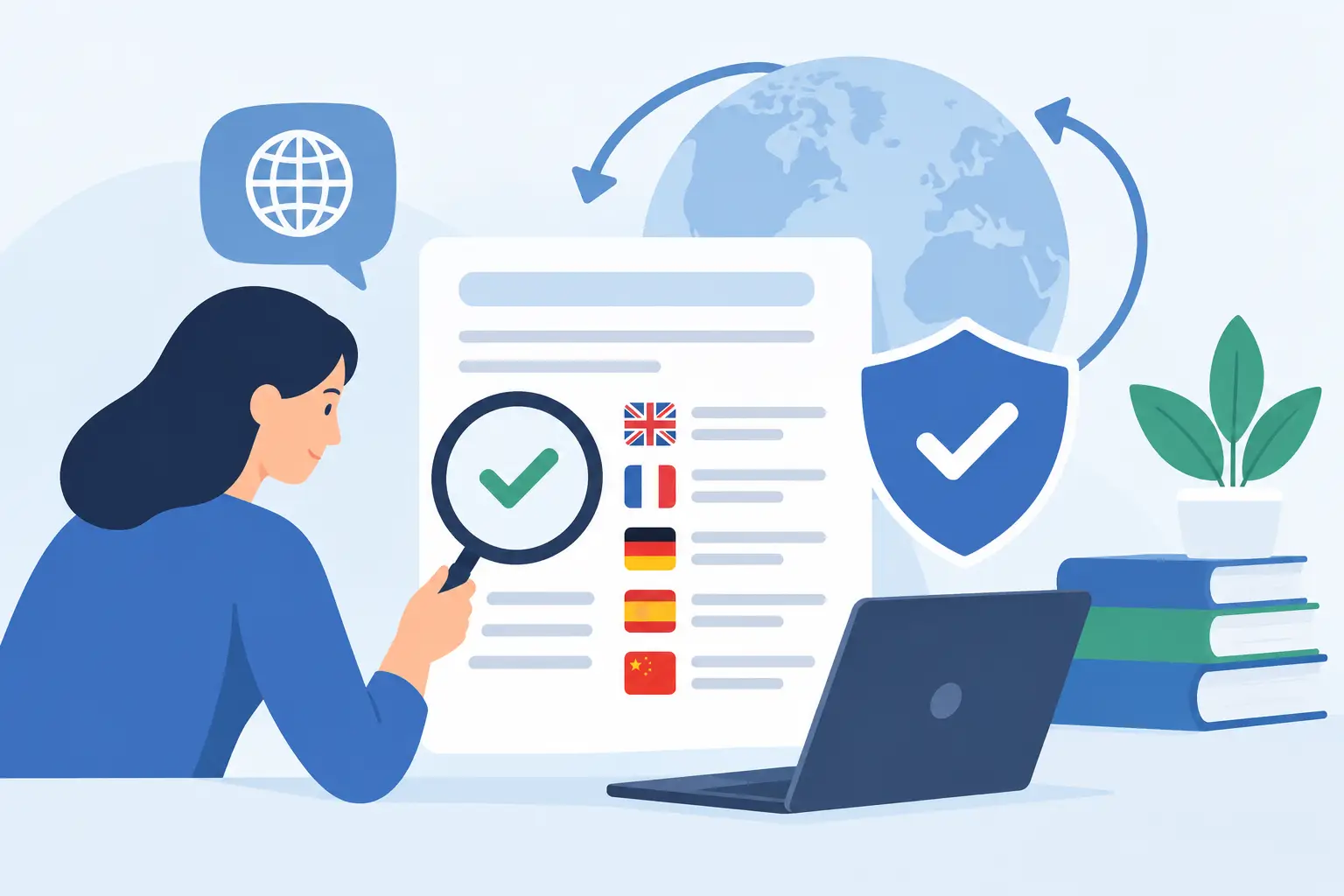
This guide to translation quality assurance explains how expert review, terminology control, and secure workflows protect high-stakes communication well.
Read more
Lenguae aims to teach language in a comprehensive way. With our courses, you will learn to understand and express yourself in both in writing and speaking, while also getting in touch with the culture of the countries that speak the language you’re learning. All our teachers are experienced in language teaching, being either native speakers or having lived abroad.
Career at Lenguae
