
Clinical Trial Document Translation That Holds Up
Clinical trial document translation supports accurate protocols, informed consent, safety reporting, and global study coordination without costly delays.
Read more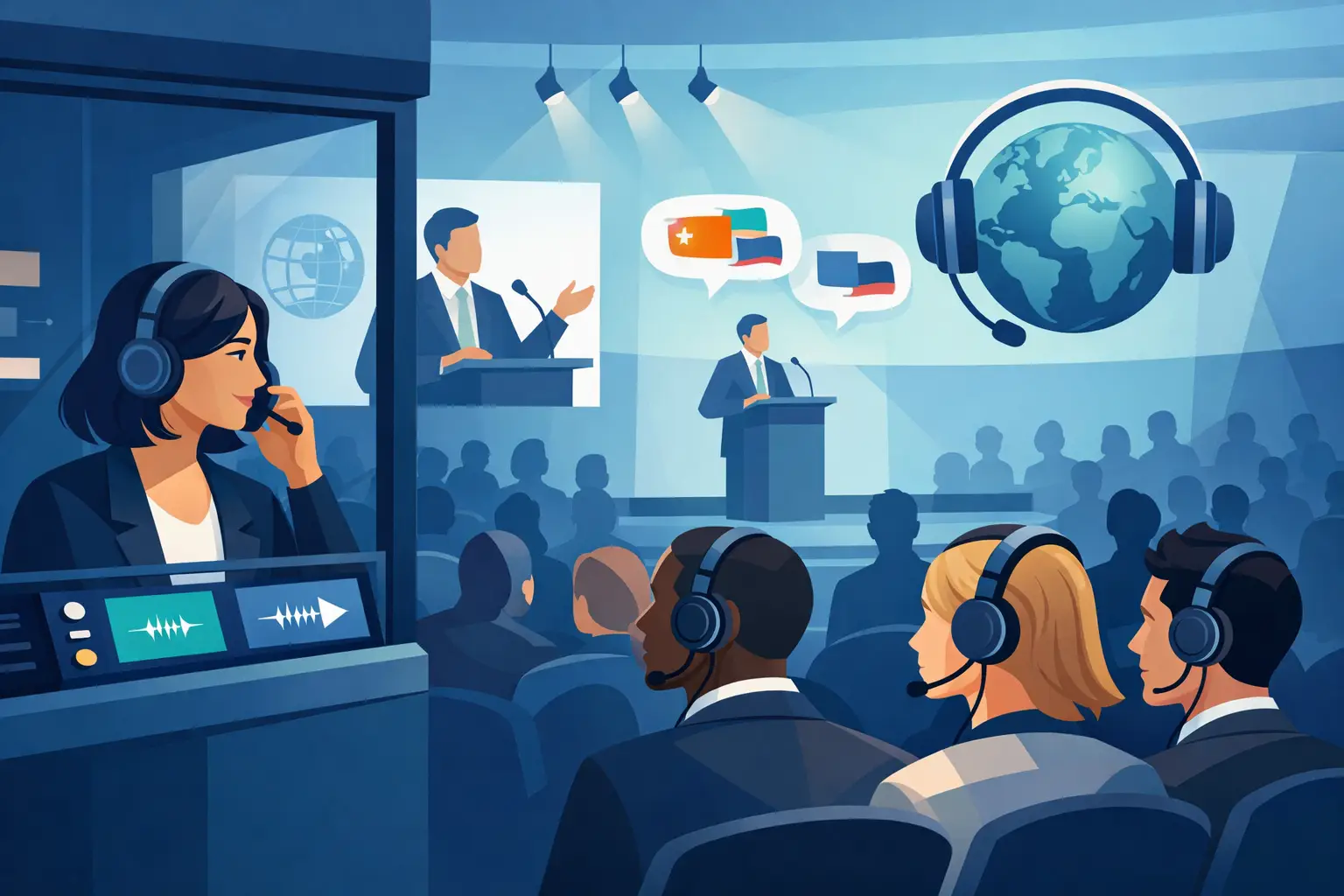
A conference can have excellent speakers, valuable research, and a full room, yet still leave part of its audience outside the conversation. Simultaneous interpretation for conferences gives multilingual attendees access to the same ideas at nearly the same moment they are delivered. For organizers, it is not simply an added service. It is a practical way to support participation, protect the accuracy of high-stakes information, and make an event genuinely accessible.
This format works especially well when presentations move quickly, multiple languages are needed, or the agenda includes technical, legal, healthcare, government, academic, or corporate content. The quality of the interpretation, audio setup, and pre-event planning will determine whether language access feels natural to attendees or becomes a distraction.
In simultaneous interpretation, a trained interpreter listens to the speaker and renders the message into another language while the speaker continues talking. Attendees listen through headsets or an event platform’s language channel. There is a brief delay, usually only a few seconds, but the presentation proceeds without the repeated pauses required by consecutive interpretation.
This differs from consecutive interpretation, where the speaker pauses after a short section so the interpreter can deliver it in the target language. Consecutive interpreting can be effective for interviews, small meetings, depositions, and one-to-one discussions. At a large conference, however, it can nearly double speaking time and disrupt a tightly planned agenda.
Simultaneous interpreting is often the stronger choice for keynote addresses, panel discussions, training sessions, product launches, scientific presentations, town halls, and multilingual public meetings. It helps attendees follow the event in real time, ask informed questions, and remain part of the shared experience.
Knowing two languages does not prepare someone to interpret a fast-moving presentation about clinical trial protocols, immigration policy, employment law, financial reporting, or specialized engineering. Conference interpreters need advanced listening, analysis, memory, speaking, and research skills. They must make accurate language decisions in seconds while preserving the speaker’s intended meaning, tone, and level of certainty.
That distinction matters when one misplaced term could confuse a patient-care audience, alter the meaning of a regulatory requirement, or weaken confidence in a business announcement. Qualified interpreters prepare for the subject matter in advance. They study agendas, speaker bios, presentations, glossaries, acronyms, and expected terminology so they can deliver clear, natural interpretation without guessing.
Cultural competence matters as much as vocabulary. Humor, examples, idioms, and references that work for one audience may require thoughtful adaptation for another. A professional interpreter does not merely replace words. They communicate the message in a way the audience can understand while staying faithful to the speaker.
The most successful multilingual events are planned with language access in mind from the first agenda draft. Waiting until speakers have finalized their slides or registration is nearly complete can limit interpreter availability and create unnecessary technical pressure.
Ask registrants which language they prefer for listening, participating, or asking questions. Attendance estimates matter because they help determine the number of receivers, remote language channels, support staff, and interpreters needed. They also help organizers decide whether every session needs interpretation or whether services should focus on the main program and selected breakout sessions.
Include the event location, dates, schedule, format, and subject matter when requesting a quote. A half-day leadership meeting with one Spanish language channel has very different needs from a two-day medical symposium serving Spanish, Mandarin Chinese, Portuguese, and Arabic speakers.
Send available materials as soon as possible, including the agenda, speaker notes, slide decks, handouts, product names, technical specifications, and prior event terminology. Confidential materials should be handled through a provider with clear confidentiality practices and professional standards.
Early preparation is particularly valuable for legal, healthcare, pharmaceutical, government, and financial events. It gives interpreters time to research terms, confirm preferred translations, and identify questions before the program begins. Last-minute slide changes happen, but they should be the exception rather than the only preparation available.
Simultaneous interpreting is mentally demanding. For longer sessions, interpreters commonly work in pairs and rotate at regular intervals. This is a quality measure, not an unnecessary extra. Fatigue can affect speed, concentration, and accuracy, especially when the content is technical or speakers move rapidly.
The right staffing model depends on the agenda, language combination, subject complexity, number of rooms, and whether interpreters must cover networking, workshops, or question-and-answer periods. A reputable language partner will explain what is needed and why, rather than applying a one-size-fits-all setup.
Excellent interpreters need reliable audio. If they cannot hear the speaker clearly, attendees cannot receive a clear interpretation. Conference interpretation may use on-site soundproof booths, interpreter consoles, microphones, transmitters, and wireless headsets. For hybrid and virtual events, interpreters work through secure remote interpreting platforms that provide separate language channels.
A sound check should cover more than the interpreters’ microphones. Test the speaker microphones, presentation audio, video clips, remote panelists, attendee headsets, platform permissions, and language-channel selection. Assign a technical contact who can solve problems quickly during the event.
For on-site programs, the physical layout deserves attention. Interpreters need a direct view of speakers and presentation screens, or a dependable video feed if the booth location does not allow it. For remote programs, speakers should use a stable internet connection, a quality headset or microphone, and a quiet room. Laptop microphones, poor lighting, and weak Wi-Fi can reduce the value of even the best interpretation.
Keynotes are usually the easiest part of a multilingual conference. Audience participation requires more planning. Decide in advance how questions will be handled: through a floor microphone, a moderator, written submissions, a chat function, or a designated bilingual facilitator.
In a live room, attendees should know which microphone to use and which language channel to select. In a virtual event, give simple instructions before the session begins and repeat them at the start of major presentations. Clear guidance prevents attendees from missing the interpretation or speaking over one another.
Breakout sessions may need separate interpreters and equipment, particularly when participants are expected to collaborate rather than listen passively. If the budget cannot support interpretation in every room, consider offering designated multilingual sessions or providing translated materials alongside interpretation for the highest-priority discussions. The best choice depends on attendee needs and the purpose of each session.
A few avoidable choices can make language access harder than it needs to be. Asking speakers to slow down slightly is reasonable. Asking them to read dense slides at high speed is not. Presenters should avoid talking over panelists, wandering away from microphones, and relying on unexplained acronyms.
Organizers also sometimes assume a bilingual employee can interpret alongside their regular duties. That can put both the employee and the event at risk, particularly when confidential, legal, medical, or technical information is involved. Professional interpreters should be able to focus exclusively on interpretation.
Another common issue is booking based only on the lowest rate. Cost matters, and a responsible provider should offer transparent, affordable options. But the most economical choice can become expensive when attendees misunderstand essential information, a session must be repeated, or language access fails at a public-facing event.
Look for a provider that asks detailed questions about your audience, industry, venue, schedule, languages, and technology. Those questions signal preparation. You should also expect interpreters with relevant subject-matter experience, a clear plan for confidentiality, and support for on-site, remote, or hybrid delivery.
For events involving sensitive information, confirm how materials and participant data will be protected. For government, healthcare, legal, and pharmaceutical settings, terminology accuracy and privacy practices should be central to the planning conversation. If your event has a short turnaround, ask what materials are needed immediately and what can be finalized later.
Lenguae helps organizations arrange professional conference interpretation across more than 50 language options, with flexible on-site and remote solutions for audiences in Connecticut, across the United States, and internationally.
When every attendee can understand the message as it happens, they can contribute with confidence. Build language access into your conference plan early, and interpretation becomes part of the event’s success rather than a last-minute accommodation.
Send us your documents
now and we will get back to
you with a free quote!
"The methodology, material and excellent teachers make Lenguae the best option for the personalized of English, as the learning.”

Clinical trial document translation supports accurate protocols, informed consent, safety reporting, and global study coordination without costly delays.
Read more
Medical records translation for patients protects clarity, privacy, and continuity of care when health information crosses languages and borders safely.
Read more
Learn how to translate legal contracts with accurate terminology, certified review, confidentiality safeguards, and a workflow built for deadlines safely.
Read more
Choose a qualified court interpreter for legal proceedings to protect rights, preserve confidentiality, and ensure clear, accurate testimony in court.
Read more
Does USCIS require certified translations? Learn the rule, required certification wording, and how to submit accurate translated documents for review.
Read more
Lenguae aims to teach language in a comprehensive way. With our courses, you will learn to understand and express yourself in both in writing and speaking, while also getting in touch with the culture of the countries that speak the language you’re learning. All our teachers are experienced in language teaching, being either native speakers or having lived abroad.
Career at Lenguae
