
Phone Interpretation Services for Critical Calls
Phone interpretation services give healthcare, legal, and government teams fast, confidential language support when a qualified interpreter is needed now.
Read more
A birth certificate in Spanish, a diploma in Korean, or a police record in Arabic may be perfectly valid in its country of origin. But if it accompanies a USCIS filing, the English translation can determine whether an officer can review the evidence without delay. So, does USCIS require certified translations? Yes – when you submit a document containing a foreign language, USCIS generally requires a full English translation accompanied by a translator certification.
This requirement is straightforward in principle, yet small mistakes can create avoidable problems. A translation that omits a stamp, fails to include a certification, or uses unclear terminology may lead to a request for evidence, a delayed decision, or confusion about an applicant’s record. The goal is not just to convert words into English. It is to provide a complete, accurate document that USCIS can confidently evaluate.
USCIS requires certified English translations for documents submitted in a foreign language. The rule applies whether the foreign-language material is central to the case or appears as part of a supporting record. Common examples include birth, marriage, divorce, and death certificates; passports and identity records; academic transcripts and diplomas; court decisions; police certificates; medical records; employment letters; financial documents; and custody records.
The requirement also extends to details that may seem minor. Seals, stamps, handwritten notes, marginal notations, headers, footers, and official annotations can carry meaning. A translator should account for these elements rather than translating only the main body text. If a document includes a signature that is not legible, for example, the translation may identify it as an illegible signature rather than guessing at a name.
There are practical exceptions. If a document is already fully in English, it does not need to be translated simply because it was issued abroad. A bilingual document may not require a separate translation if all relevant content appears clearly and completely in English. When only part of a document is in another language, the foreign-language portion still needs an English translation.
For USCIS purposes, certification does not mean a government agency has approved the translation. It means the translator or translation provider supplies a signed statement confirming two things: the translation is complete and accurate, and the translator is competent to translate from the original language into English.
A USCIS translation certification should identify the language pair and include the translator’s name, signature, and date. It should also provide contact information. While USCIS does not require one exact sentence, a clear certification statement typically says that the translator certifies they are competent to translate from the source language into English and that the attached translation is complete and accurate to the best of their knowledge and belief.
The certification should accompany the translated document. In most cases, applicants submit a copy of the original foreign-language document, the complete English translation, and the signed certification. Keeping these materials together helps an officer match the translation to the source document quickly.
A common misunderstanding is that USCIS requires notarization. It generally does not. The translator’s signed certification is the core requirement. Notarization may be requested by another organization, such as a school, court, state agency, or foreign consulate, but it is not usually necessary for a USCIS filing unless specific case instructions say otherwise.
Notarization and certification serve different purposes. A notary verifies the identity of the person signing a document. A translation certification attests to the translation’s accuracy and the translator’s competence. A notarized translation without a proper certification statement may still fall short of USCIS expectations.
These terms are also easy to confuse. A certified copy is a copy authenticated by the issuing authority or custodian of the original record. A certified translation is an English rendering accompanied by the translator’s certification. Depending on the filing, USCIS may ask for an original, a certified copy, or a plain copy of the source document. That evidentiary question is separate from the translation requirement.
Similarly, an apostille or legalization does not replace a certified English translation. Those processes address the recognition of a foreign public document. USCIS still needs to be able to read the document in English.
For immigration filings, completeness matters. Translating only selected excerpts is risky unless USCIS specifically permits a summary or the document itself is limited to the relevant portion. Officers need context to assess dates, issuing authorities, registration numbers, document titles, and qualifications that may affect the evidence.
A complete translation should preserve the structure and meaning of the original without trying to make it look like a newly issued US document. Names, dates, places, and numbers must be handled carefully. Transliteration can matter, particularly when a name appears differently across a passport, birth certificate, marriage record, and prior immigration filing. The translator should translate the content accurately, not silently correct discrepancies in the source record.
Terminology also deserves attention. Legal and civil-status terms often do not map neatly from one country to another. A professional translator may retain the original term where needed and provide a clear English equivalent or explanation in brackets. That approach preserves the document’s meaning without overstating what a foreign title, court action, or government record represents under US law.
USCIS does not publish a universal list of approved translators or require that the translator hold a particular license. In theory, any competent person who can accurately translate the document and sign the certification may do so.
In practice, the stakes should guide the choice. Using a relative, friend, or applicant can create concerns about impartiality, competence, or unintentional omissions, especially for documents involving names, legal history, family relationships, medical information, or employment qualifications. Machine translation alone is also a poor fit for a USCIS submission. It may mistranslate official terms, fail to reproduce document formatting, or overlook handwritten content and stamps.
Professional certified translation is particularly valuable when documents are complex, hard to read, handwritten, issued in less commonly supported languages, or needed on a tight filing schedule. It also provides a clearer record of who completed the work and how to address questions if they arise.
A filing can be delayed by issues that appear small at first glance. Before submitting, review the translation package for the following:
For online filings, scan both the original document and translation at a readable resolution. If a document has information on both sides, include both sides. Labeling files clearly can also reduce confusion when several translated records are submitted at once.
USCIS translations often serve more than one purpose. The same birth certificate, academic record, or marriage document may later be needed for a visa interview, employer onboarding, school enrollment, a driver’s license application, or an overseas consular process. Ordering a careful translation from the start can prevent duplicated work and conflicting versions later.
Confidentiality matters, too. Immigration records can contain addresses, identification numbers, medical details, financial information, and sensitive family history. Choose a provider with clear handling practices and translators experienced in confidential, high-stakes documents. At Lenguae, native human translators support certified document translation with careful terminology, protected information, and flexible turnaround options for immigration needs.
A well-prepared translation gives your evidence the clarity it deserves. Before filing, make sure each foreign-language page has a complete English counterpart and a proper certification, then keep a copy of the full package for your records. That small measure of care can help your application move forward with fewer questions and greater confidence.
Send us your documents
now and we will get back to
you with a free quote!
"The methodology, material and excellent teachers make Lenguae the best option for the personalized of English, as the learning.”

Phone interpretation services give healthcare, legal, and government teams fast, confidential language support when a qualified interpreter is needed now.
Read more
Choose the best medical translation providers with confidence. Learn what protects patient safety, supports compliance, and keeps every records clear.
Read more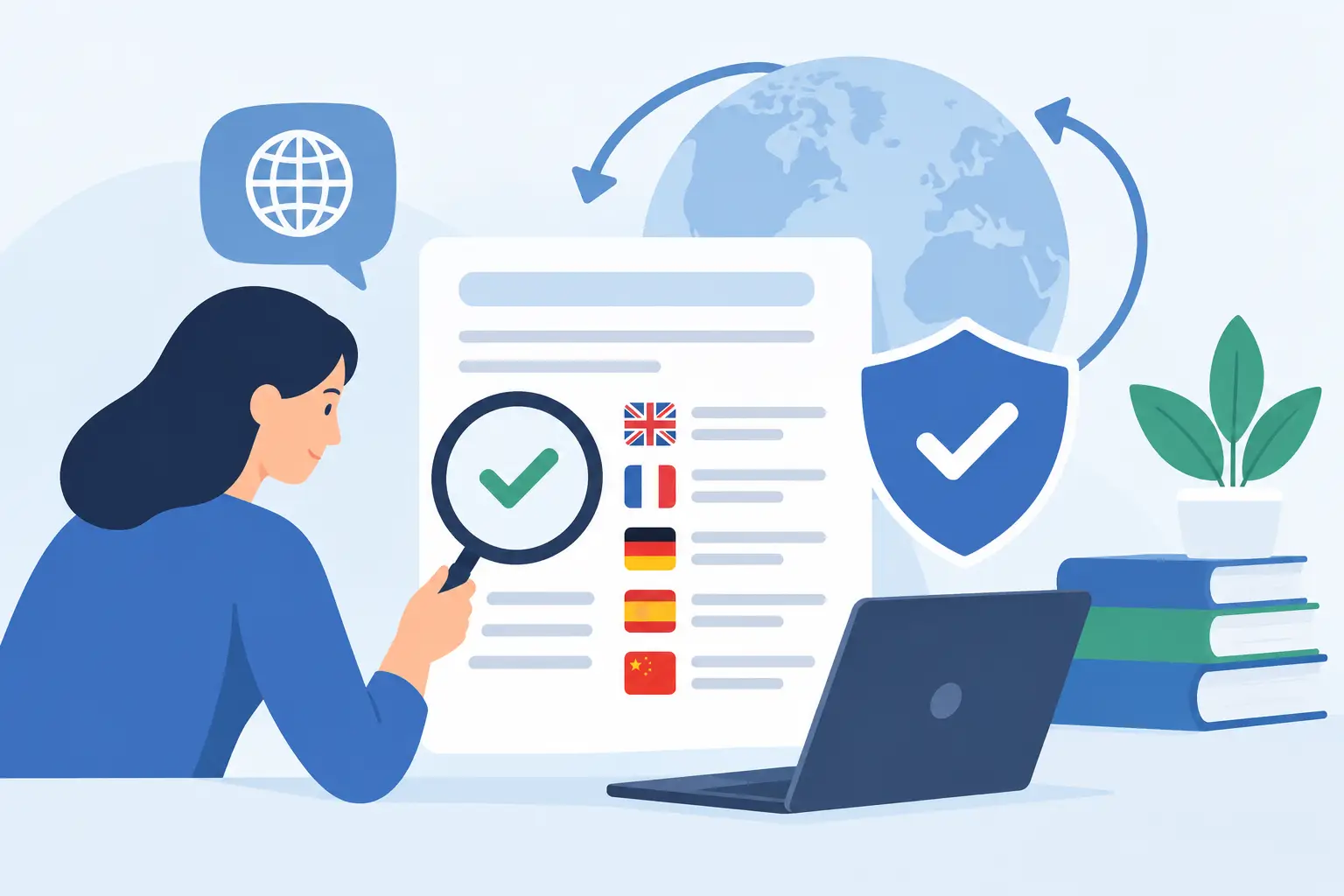
This guide to translation quality assurance explains how expert review, terminology control, and secure workflows protect high-stakes communication well.
Read more
Pharmacovigilance translation services support clear, compliant safety reporting across languages, protecting patients and helping teams meet deadlines.
Read more
Human versus machine translation affects accuracy, privacy, cost, and speed. Learn when expert linguists protect your most important communication needs.
Read more
Lenguae aims to teach language in a comprehensive way. With our courses, you will learn to understand and express yourself in both in writing and speaking, while also getting in touch with the culture of the countries that speak the language you’re learning. All our teachers are experienced in language teaching, being either native speakers or having lived abroad.
Career at Lenguae
