
Medical Consent Translation That Protects Patients
Medical consent translation protects patient choice, supports informed care, and helps providers communicate clearly across languages and cultures safely.
Read more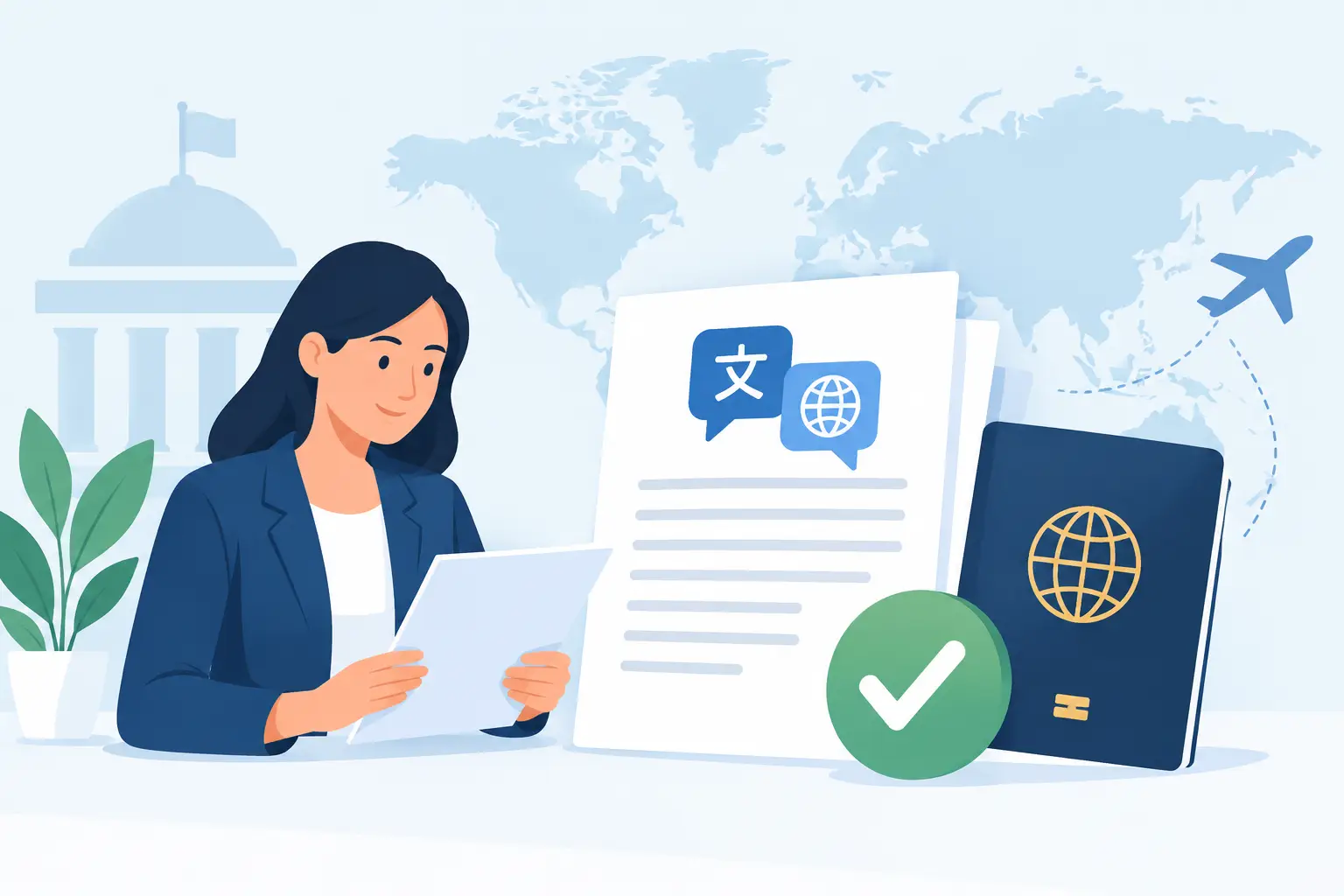
A missing stamp on a birth certificate, one mistranslated job title, or an omitted handwritten note can create questions that slow an immigration filing. Strong immigration translation results are not about making a document sound better in English. They are about giving USCIS, an attorney, or a consular officer a complete, accurate version of the original document so the evidence can be reviewed with confidence.
For applicants and legal teams, the right translation partner reduces avoidable delays while protecting sensitive personal information. The work requires more than fluency. It requires careful document handling, knowledge of immigration documentation, and a clear certification statement that supports the filing.
A useful immigration translation preserves the meaning, structure, and evidentiary value of the source document. Names, dates, addresses, government seals, annotations, stamps, signatures, and marginal notes all matter. Even when a stamp cannot be translated word for word, its presence and purpose should be indicated in the English version.
The result should be complete and readable. A reviewer should be able to compare the translation with the original and understand what each section says without guessing. That standard applies to straightforward civil records as well as more complex evidence such as court decisions, academic transcripts, medical records, employment letters, financial documents, and police certificates.
Accuracy also means resisting the urge to “improve” the source. If a document contains an inconsistency, an unusual spelling, or a formatting error, the translation should reflect it faithfully. Changing a fact to make it appear more consistent can create a larger problem when records are reviewed together.
For many US immigration submissions, a foreign-language document must be accompanied by a full English translation and a certification from the translator or translation provider. The certification generally confirms that the translation is complete and accurate and that the translator is competent to translate between the languages.
A notarization is different. It verifies the identity of the person signing a statement, not the quality of the translation itself. Some situations may call for notarization or other formal handling, but it is not automatically required for every immigration document. Your attorney or the agency receiving the records can confirm the requirements for your specific filing.
Immigration cases bring together records from different countries, government systems, and stages of life. Civil documents are common, including birth, marriage, divorce, and death certificates. Applicants may also need translations of passports, national identity cards, household registers, name-change records, and military documents.
Employment-based and family-based matters often require additional evidence. This can include diplomas, academic transcripts, professional licenses, tax records, pay statements, bank letters, employer verification letters, adoption documents, custody orders, or affidavits. In more sensitive cases, supporting evidence may involve medical reports, criminal court records, restraining orders, or documents connected to asylum and humanitarian petitions.
Each category carries its own terminology. A legal ruling should be handled by a translator who understands legal phrasing and procedural terms. Medical documentation needs equally careful treatment because a condition, diagnosis, or treatment history can be misunderstood if terminology is generalized. A literal word-for-word approach is not always accurate, but neither is a loose paraphrase. The goal is precise meaning in clear English.
Translation is one component of an immigration case, not a guarantee of approval. Eligibility, deadlines, supporting evidence, and legal strategy all affect the outcome. Still, translation quality can directly affect whether an officer can evaluate the evidence efficiently and accurately.
Incomplete translations can prompt requests for additional evidence or force a legal team to revisit documents close to a deadline. Incorrect dates, omitted notations, and inconsistent name spellings can raise questions about identity, family relationships, education, or employment history. A document that appears minor to the applicant may be central to the reviewer.
This is especially relevant when a name has been transliterated from a non-Latin alphabet. Several valid English spellings may exist for the same name. The translator should preserve the spelling shown on the document while the applicant and legal team identify differences across records. Where appropriate, a translator’s note can clarify a term, seal, or local administrative designation without changing the underlying content.
A translation should account for the full document, not only the paragraphs that seem relevant. That includes headers, footers, stamps, seals, registration numbers, checkboxes, handwritten entries, and reverse-side text. If text is illegible, the translation should say so rather than invent a reading.
Completeness is also practical. Immigration officers should not need to wonder whether a stamp was overlooked or whether a page was intentionally excluded. Delivering every translated page in an organized format supports faster review and gives attorneys a more dependable record for their files.
The quality of the source file has a major effect on the final translation. Send a clear, complete scan or photograph of every page, including the front and back where applicable. Avoid cropped images, shadows over text, and low-resolution screenshots. If an original has faint handwriting or an embossed seal, let the translation team know and provide the clearest available copy.
Share the filing purpose at the start. A translation intended for a USCIS petition, consular processing, an immigration court matter, or an attorney’s evidence packet may require different formatting or delivery timelines. Context helps the translator use the right terminology, especially for government titles, schools, courts, employers, and local administrative units.
It also helps to provide any known preferred spellings for names and addresses. Do not ask a translator to change the source document’s spelling, but do flag variations so they can be handled consistently and brought to the attention of your attorney if necessary. If a filing deadline is close, request the translation early enough to allow for quality review and questions about unclear text.
The lowest price is not always the lowest risk. Immigration documents contain personal identifiers, family information, financial details, and sometimes highly sensitive medical or legal records. A professional provider should have a clear process for confidentiality, secure file handling, and quality control.
Ask whether the translation will include a signed certification statement, whether the provider uses qualified human translators, and whether the translator has experience with the relevant document type. It is also reasonable to ask about turnaround time, revision procedures, accepted file formats, and how the team handles illegible sections or missing pages.
For cases involving multiple documents, consistency deserves special attention. The same person, institution, and location should be rendered consistently across the entire set unless the source documents use different forms. A coordinated review can identify discrepancies before the package reaches an attorney or agency.
A dependable process begins with a review of the documents, language pair, purpose, and deadline. The translation is then assigned to a qualified linguist with relevant subject knowledge. A second review helps verify names, dates, terminology, completeness, and formatting before the certification is prepared.
At Lenguae, certified document translation is handled with the care high-stakes immigration records require. Native human translators, broad language coverage, and responsive project coordination help individuals, attorneys, and relocation teams receive accurate translations without unnecessary complexity. Confidentiality and practical turnaround expectations remain central from intake through delivery.
When a document is unclear or includes a country-specific term with no exact US equivalent, transparency is the right response. A professional translation should accurately convey the term and, when useful, provide a brief clarifying note. That gives the reader context without overstating what the original says.
Before you file, take one final look at the original and translated versions together. Confirm that every page is present, names and dates have been checked, and the certification is included. Careful preparation gives your evidence the best chance to speak clearly when it matters most.
Send us your documents
now and we will get back to
you with a free quote!
"The methodology, material and excellent teachers make Lenguae the best option for the personalized of English, as the learning.”
Medical consent translation protects patient choice, supports informed care, and helps providers communicate clearly across languages and cultures safely.
Read more
Conference interpreters help multilingual events run clearly and confidently. Learn how to choose the format, team, and preparation for every audience.
Read more
Medical translation protects patient safety, supports informed consent, and helps healthcare teams deliver clear, compliant care across languages safely.
Read more
Government translation gives agencies accurate, confidential communication and interpretation so residents can access vital public services with confidence.
Read more
Emergency language interpretation gives healthcare, legal, and public agencies fast, accurate support when clear communication cannot wait in crises.
Read more
Lenguae aims to teach language in a comprehensive way. With our courses, you will learn to understand and express yourself in both in writing and speaking, while also getting in touch with the culture of the countries that speak the language you’re learning. All our teachers are experienced in language teaching, being either native speakers or having lived abroad.
Career at Lenguae
