
Phone Interpretation Services for Critical Calls
Phone interpretation services give healthcare, legal, and government teams fast, confidential language support when a qualified interpreter is needed now.
Read more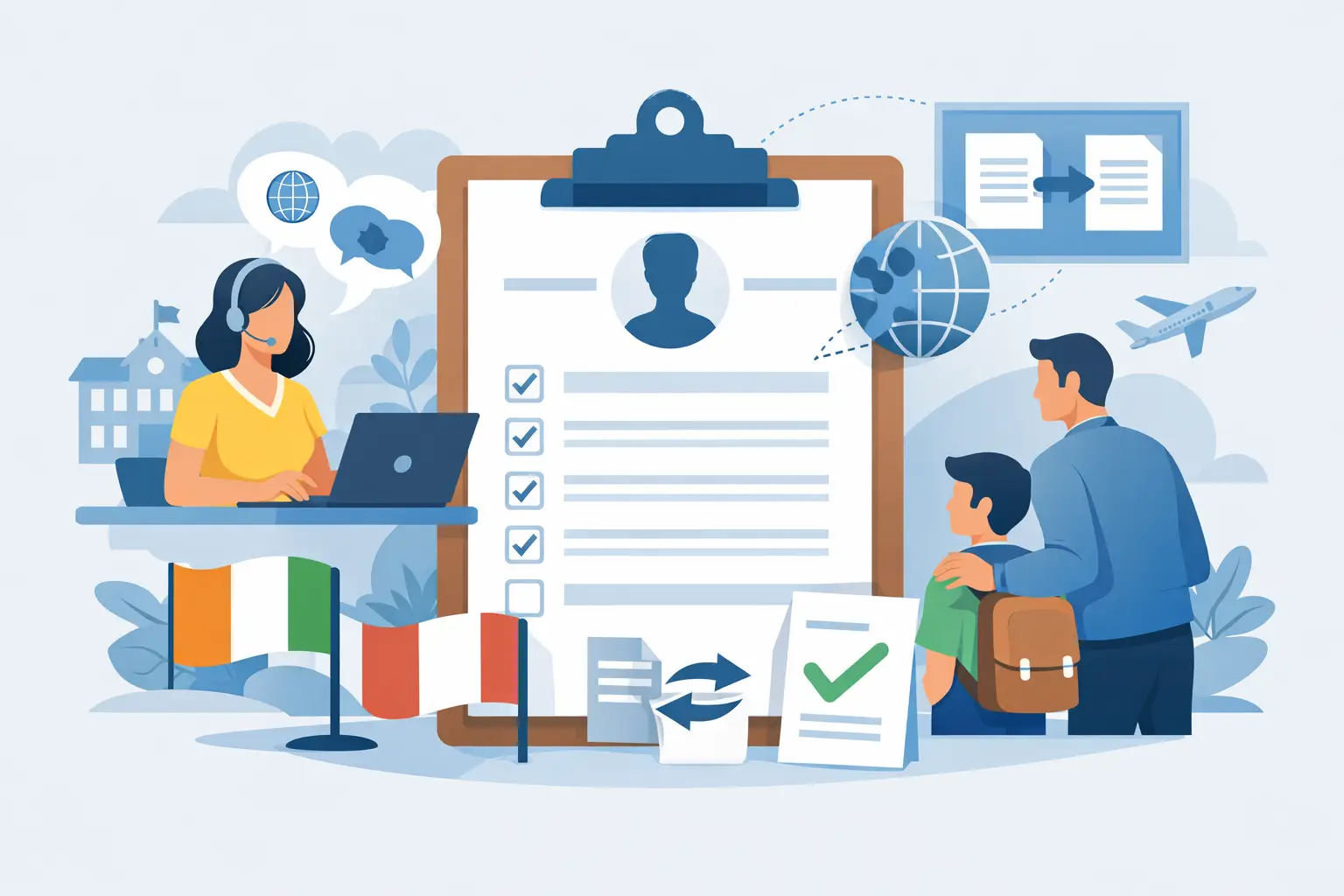
A missed vaccination field, an unclear custody question, or a parent who cannot understand an emergency-contact instruction can delay a child’s first day of school. School enrollment form translation is not simply a matter of replacing English words with another language. It is a practical safeguard for families, school staff, and districts that need every enrollment decision to be accurate, timely, and fair.
For schools serving multilingual communities, translated registration materials help parents provide the information educators need while demonstrating that every family is welcome to participate. For families arriving from another country or relocating within the United States, accurate translation can make an unfamiliar enrollment process far less stressful.
The phrase can describe two related, but distinct, needs. A district may need its own blank enrollment packet translated into the languages commonly used by local families. That packet may include registration forms, home-language surveys, residency questionnaires, medical history forms, consent notices, technology agreements, transportation requests, and family handbooks.
A family may also need documents from another country translated into English for submission to a public school, private school, college preparatory program, or university. Common examples include birth certificates, passports, prior school records, report cards, transcripts, immunization records, special education documents, custody orders, and proof-of-address documents.
These projects require different workflows. District-facing materials often need careful formatting so translated forms remain easy to complete and align with the English original. Family documents may require a certified translation, depending on the school’s policy and the type of record. Before ordering a translation, confirm whether the receiving school requires certification, whether it accepts digital copies, and whether it has its own form or statement requirements.
Enrollment forms affect more than administrative records. They can determine where a student is placed, which health requirements must be met, who can pick up the child, what language support may be appropriate, and how a school reaches a family in an emergency.
A literal translation is not always an accurate one. School terminology varies by state and district. Terms such as “legal guardian,” “proof of residency,” “grade placement,” “home language,” and “free and reduced-price meals” may not have a direct one-to-one equivalent in another language. A qualified translator considers the intent of the form, the education system familiar to the reader, and the need to preserve the original legal meaning.
This is especially relevant for consent forms and notices involving student records. Translators must distinguish between plain-language instructions and language that carries a specific legal or regulatory meaning. A confusing translation can produce incomplete forms, avoidable follow-up calls, and uncertainty about whether a parent understood what they signed.
Accuracy also protects the student. When immunization histories, medical action plans, allergy information, or medication authorization documents are translated incorrectly, the consequences can extend beyond a delayed registration. Education translation should be handled with the same care given to healthcare and legal documentation.
A school’s enrollment packet is often created over time, with forms added by transportation, health, technology, nutrition, and student-services teams. The result may be a lengthy collection of documents with repeated instructions, abbreviations, scanned pages, and fillable fields. Sending that packet for translation without preparation can create unnecessary cost and inconsistencies.
Start by identifying which documents are required at initial registration and which are optional or situation-specific. Then confirm the current English versions are final. If the English packet changes every few weeks, translated versions will quickly become outdated.
A professional language partner can create a glossary for recurring district terms, school names, program titles, and job roles. This helps ensure that a term such as “English learner services” is translated consistently across registration forms, notices, websites, and family communications. Consistency builds confidence. Parents should not have to wonder whether two different translated phrases refer to the same program.
Formatting deserves equal attention. A translated form may expand significantly compared with English, particularly in languages such as Spanish, Portuguese, Arabic, or French. Forms need enough space for text, checkboxes, signatures, dates, and handwritten responses. A translation that is linguistically correct but crowded, misaligned, or difficult to print can still fail the family using it.
For districts with a wide range of language needs, it may make sense to translate the full enrollment packet into high-demand languages and provide professional interpretation or on-demand translation for less common languages. The right balance depends on enrollment trends, legal obligations, the urgency of registration, and the district’s budget.
Bilingual staff and community volunteers can be valuable cultural bridges, but they should not be asked to carry the full burden of translating enrollment documents or interpreting sensitive meetings without appropriate qualifications. They may lack training in education terminology, confidentiality, or impartial interpretation.
Children should never be expected to interpret conversations about health, custody, immigration-related paperwork, disability services, or family finances. This places pressure on the child and risks incomplete or inaccurate communication. Professional interpreters allow parents to ask questions directly and participate fully in decisions affecting their child.
Families enrolling after an international move often have documents issued in another language and educational format. Schools may need to review academic records for grade placement, confirm identity and age, or evaluate health documentation. In these cases, the translation should preserve every relevant detail, including stamps, seals, grades, handwritten entries, dates, and explanatory notes.
The goal is not to redesign the record into an American transcript unless the receiving institution specifically requests an evaluation. Translation and credential evaluation are separate services. A translator renders the content accurately into English. A credential evaluator may later determine how coursework, credits, or grading systems compare with U.S. standards.
Families should avoid editing, summarizing, or translating documents themselves when a school requests a professional or certified translation. Even a well-intentioned summary can omit information the registrar needs. A complete translation gives the school a reliable record to review and helps prevent repeated requests for clarification.
Certification generally means the translation is accompanied by a signed statement from the translator or translation company affirming that the translation is complete and accurate to the best of their knowledge and ability. It does not automatically mean notarization. If a school asks for a notarized translation, confirm that requirement before the project begins, since the two services serve different purposes.
Enrollment materials can contain addresses, dates of birth, student identification numbers, medical details, family income information, custody arrangements, and immigration-related records. Schools and families should know how these files will be transmitted, stored, and handled.
Professional translators work under confidentiality expectations and should receive only the information needed for the assignment. For districts, a clear process for version control, secure file transfer, review, and approved final files can reduce the risk of outdated forms or unintended disclosures. For individual families, secure digital submission can be particularly helpful when deadlines are close and original documents must remain protected.
Translated forms make information available before and after enrollment, but they do not replace a live conversation. Parents may still need to ask how residency rules apply, explain an immunization record, discuss transportation, or understand a school program. In-person, video remote, and telephone interpreters can support those interactions in the language the family prefers.
This combined approach is often the most effective: written materials provide a reference families can revisit, while professional interpretation makes room for questions and informed consent. It also helps front-office staff move through registration efficiently without asking parents to return multiple times.
For education organizations, choosing a language partner with native translators, subject-matter experience, secure processes, and flexible turnaround options helps turn a complex enrollment packet into an inclusive point of welcome. Lenguae supports schools and families with accurate document translation and interpretation tailored to time-sensitive, confidential communication.
A child’s enrollment should begin with clear information, not a language barrier. When forms and conversations are handled with care, families can focus on what matters most: helping their student begin school prepared, supported, and ready to belong.
Send us your documents
now and we will get back to
you with a free quote!
"The methodology, material and excellent teachers make Lenguae the best option for the personalized of English, as the learning.”

Phone interpretation services give healthcare, legal, and government teams fast, confidential language support when a qualified interpreter is needed now.
Read more
Choose the best medical translation providers with confidence. Learn what protects patient safety, supports compliance, and keeps every records clear.
Read more
This guide to translation quality assurance explains how expert review, terminology control, and secure workflows protect high-stakes communication well.
Read more
Pharmacovigilance translation services support clear, compliant safety reporting across languages, protecting patients and helping teams meet deadlines.
Read more
Human versus machine translation affects accuracy, privacy, cost, and speed. Learn when expert linguists protect your most important communication needs.
Read more
Lenguae aims to teach language in a comprehensive way. With our courses, you will learn to understand and express yourself in both in writing and speaking, while also getting in touch with the culture of the countries that speak the language you’re learning. All our teachers are experienced in language teaching, being either native speakers or having lived abroad.
Career at Lenguae
