
Phone Interpretation Services for Critical Calls
Phone interpretation services give healthcare, legal, and government teams fast, confidential language support when a qualified interpreter is needed now.
Read more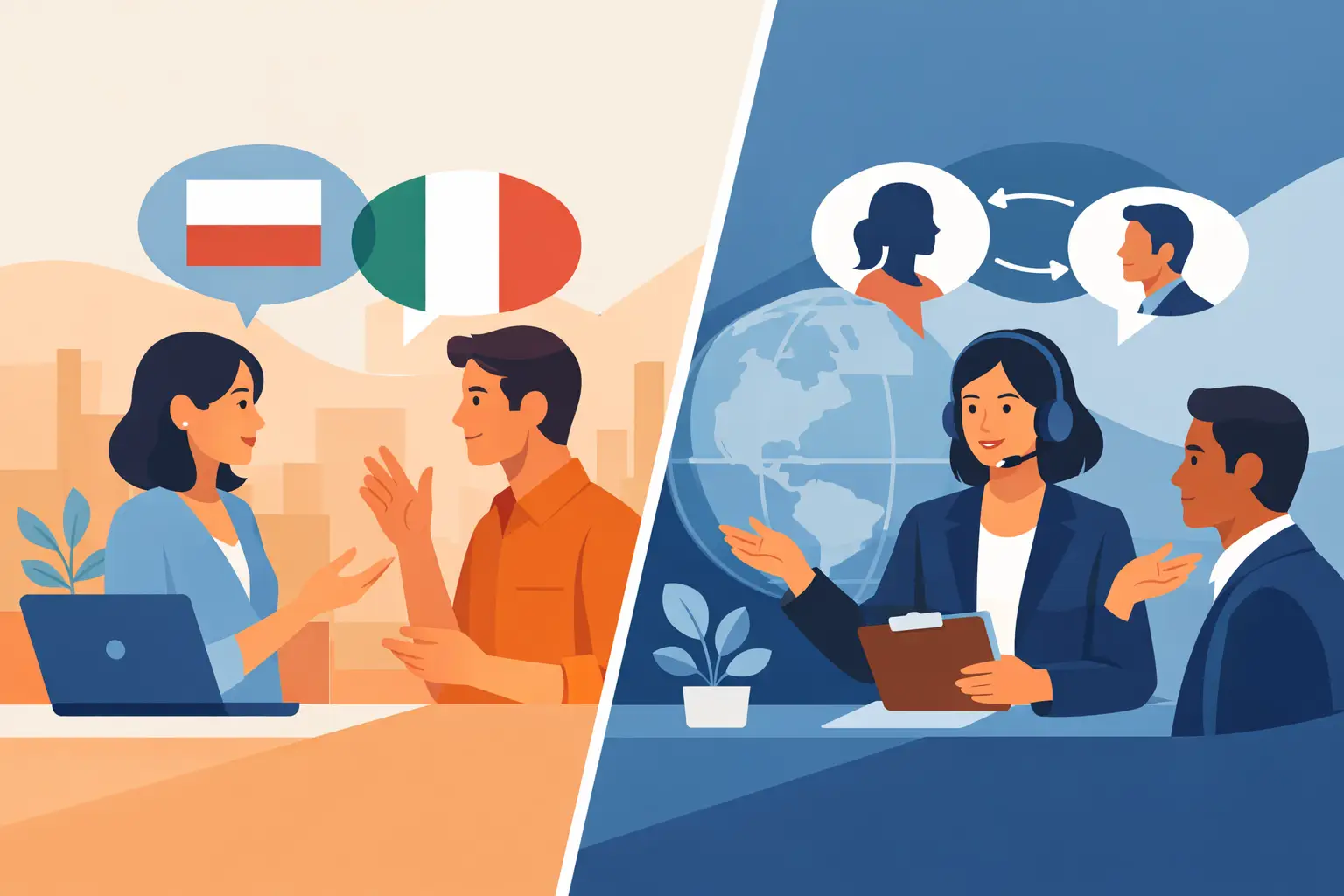
A bilingual employee may be the person everyone turns to when a client, patient, parent, or colleague speaks another language. That instinct is understandable, but bilingual staff versus professional interpreters is not simply a question of who speaks two languages. It is a decision about accuracy, confidentiality, role boundaries, and whether every participant can fully understand and be understood.
For a casual greeting, basic directions, or a non-sensitive conversation, a bilingual employee may be the right resource. When communication affects medical care, legal rights, immigration status, education services, employment decisions, or public access, professional interpretation provides protections that language ability alone cannot guarantee.
Bilingual staff bring real value to organizations. They can build trust with multilingual communities, recognize cultural context, and make everyday interactions more welcoming. A bilingual receptionist who can greet a Spanish-speaking visitor or a caseworker who understands a client’s preferred language can improve the experience immediately.
Interpretation, however, is a specialized professional skill. An interpreter listens to a message in one language, accurately conveys its meaning in another, and manages the exchange without adding, omitting, simplifying, or influencing the content. That requires more than vocabulary. It calls for active listening, short-term memory, note-taking, command of specialized terminology, cultural awareness, and the discipline to remain impartial.
Consider a healthcare appointment. A staff member may understand everyday Spanish but not know how to render terms such as contraindication, dosage adjustment, informed consent, or adverse reaction. In a legal setting, the difference between “may,” “must,” and “should” can materially affect a person’s choices. The risk is not that bilingual employees lack commitment. The risk is asking them to perform a high-stakes role without the training, preparation, or safeguards it requires.
The right choice depends on what is being communicated, who is affected, and what could happen if the message is incomplete or wrong. A useful starting point is to assess the consequence of misunderstanding rather than the apparent simplicity of the conversation.
Professional interpreters are especially important when providers discuss symptoms, diagnoses, treatment options, medication instructions, procedures, discharge plans, consent, mental health, or end-of-life decisions. Patients need the same opportunity to ask questions and make informed decisions regardless of the language they speak.
Using a trained interpreter also helps clinicians communicate directly with the patient rather than speaking through an employee or family member. This supports patient dignity, improves clarity, and reduces the chance that a sensitive detail is softened, skipped, or misunderstood. Remote video or phone interpretation can provide a practical option for urgent appointments and less common languages, while on-site interpreters may be preferred for complex consultations or longer care discussions.
Legal and immigration communication often involves deadlines, sworn statements, interviews, hearings, rights advisories, and documents with lasting consequences. Here, accuracy must be paired with impartiality and confidentiality. An interpreter should convey what is said, not explain legal strategy, advise a client, or substitute their own understanding for a speaker’s words.
A bilingual employee can be a valuable point of contact, but should not be expected to interpret a deposition, attorney-client meeting, immigration interview, administrative hearing, or police interaction unless they are qualified for that assignment. Depending on the proceeding and jurisdiction, specific interpreter credentials or court approval may also be required.
Schools and universities serve families with different language backgrounds, and meaningful access goes beyond translating a flyer. Parent-teacher conferences, special education meetings, disciplinary conversations, enrollment discussions, and academic planning can involve complex terminology and important family decisions.
A professional interpreter helps parents participate as equal partners. The interpreter can preserve the meaning of both the educator’s explanation and the parent’s concerns without turning a student, sibling, or bilingual staff member into the go-between. This matters particularly when privacy, disability services, or a student’s well-being is involved.
In corporate settings, bilingual staff may support routine collaboration, but professional interpreters are often the safer choice for negotiations, safety briefings, regulatory training, investigations, executive meetings, clinical research discussions, and technical presentations. A missed safety instruction or improperly interpreted protocol can create operational, financial, and compliance consequences.
Industry-specialized interpreters prepare for the subject matter and learn approved terminology before the session. That preparation allows the conversation to move efficiently while protecting the precision that technical work demands.
Professional interpretation is not just language conversion. It is a controlled communication service designed to make a conversation accessible without changing its substance.
First, trained interpreters work toward completeness and accuracy. They ask for clarification when a speaker’s wording is unclear rather than guessing. They distinguish between similar terms and preserve qualifiers, tone, and intent as faithfully as possible.
Second, they understand role boundaries. A professional interpreter does not summarize because a message seems repetitive, answer questions on behalf of a client, or give personal advice. That impartiality is essential when power dynamics are present, including medical visits, HR meetings, legal consultations, and government appointments.
Third, professional interpreters are expected to protect confidential information. Organizations handling protected health information, legal records, personnel matters, financial information, or sensitive government communications need language support that follows clear confidentiality practices. A bilingual staff member may be trustworthy, but placing them in an unnecessary conflict of interest can be unfair to both the employee and the person seeking services.
Finally, qualified interpreters bring cultural competence without assuming that culture speaks for an individual. They can recognize when a direct word-for-word rendering may not communicate the intended meaning and handle the exchange appropriately, while keeping the speaker in control of their own message.
Organizations do not need to exclude bilingual employees from multilingual communication. The goal is to use their abilities responsibly. Bilingual staff are often well suited to informal interactions, relationship-building, basic customer service, and operational tasks within the scope of their role.
For example, an employee might welcome a visitor, help identify their preferred language, explain that an interpreter is being arranged, or provide non-sensitive logistical information. They may also translate straightforward internal communication if they have been evaluated and assigned that responsibility.
The boundary becomes clearer when the conversation requires interpretation between two parties, includes personal or protected information, involves specialized terminology, or could influence a decision, benefit, treatment, right, or outcome. In those moments, assigning a professional interpreter protects everyone involved, including the bilingual employee.
Before assigning language support, ask four questions:
If the answer to any of these questions is yes, professional interpretation is usually the appropriate path. The delivery method can still be flexible. Scheduled on-site interpretation works well for hearings, conferences, care planning, and complex meetings. Video remote interpretation supports face-to-face communication when an on-site interpreter is not available. Telephone interpretation can be effective for brief, urgent, or unplanned needs.
Planning ahead improves the experience. Share the meeting purpose, expected duration, languages needed, names or acronyms, and any relevant terminology with the language services provider. For technical or legal matters, preparation materials can help the interpreter use consistent terminology while maintaining confidentiality. Build in enough time for interpretation rather than treating it as an interruption to the meeting.
The most effective organizations do not wait until a critical conversation begins to decide who will interpret. They create a clear language-access process: identify a person’s preferred language, document how to request an interpreter, define when bilingual staff may assist, and give employees a simple way to obtain qualified support.
This approach reduces delays and removes pressure from bilingual employees who may otherwise be asked to interpret beyond their training. It also sends a direct message to clients, patients, families, and community members: your participation matters, and your language will not be a barrier to receiving accurate information.
Lenguae helps organizations match the assignment to the situation, with professional interpreters for healthcare, legal, education, government, corporate, and event settings in person or remotely. The right language partner makes it easier to respond quickly without compromising accuracy or confidentiality.
When the conversation carries real consequences, choose the person trained to carry every word with care. That decision gives bilingual staff the respect they deserve and gives every participant a fairer, clearer voice.
Send us your documents
now and we will get back to
you with a free quote!
"The methodology, material and excellent teachers make Lenguae the best option for the personalized of English, as the learning.”

Phone interpretation services give healthcare, legal, and government teams fast, confidential language support when a qualified interpreter is needed now.
Read more
Choose the best medical translation providers with confidence. Learn what protects patient safety, supports compliance, and keeps every records clear.
Read more
This guide to translation quality assurance explains how expert review, terminology control, and secure workflows protect high-stakes communication well.
Read more
Pharmacovigilance translation services support clear, compliant safety reporting across languages, protecting patients and helping teams meet deadlines.
Read more
Human versus machine translation affects accuracy, privacy, cost, and speed. Learn when expert linguists protect your most important communication needs.
Read more
Lenguae aims to teach language in a comprehensive way. With our courses, you will learn to understand and express yourself in both in writing and speaking, while also getting in touch with the culture of the countries that speak the language you’re learning. All our teachers are experienced in language teaching, being either native speakers or having lived abroad.
Career at Lenguae
