
How Conference Interpreters Support Better Events
Conference interpreters help multilingual events run clearly and confidently. Learn how to choose the format, team, and preparation for every audience.
Read more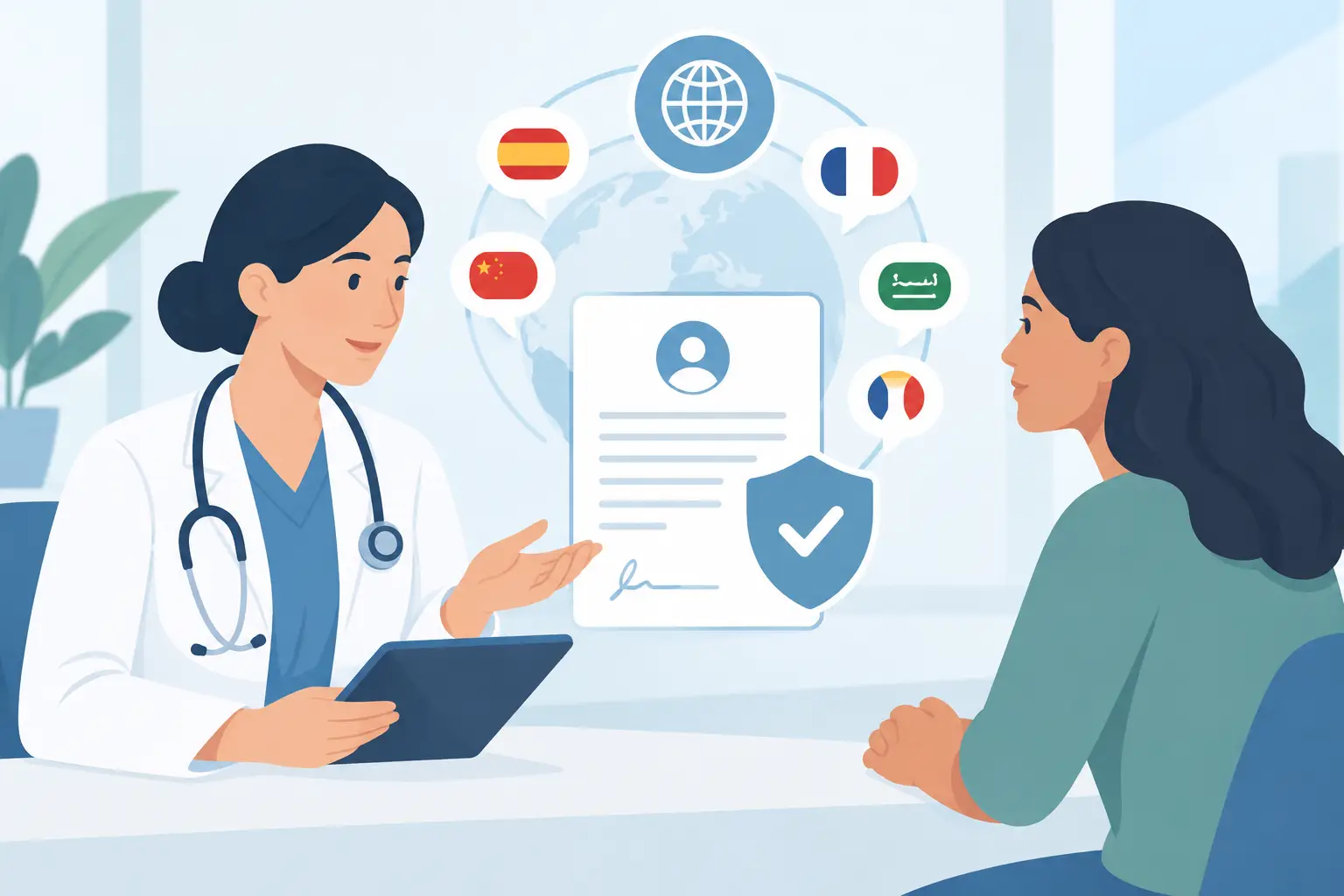
A signature on a consent form is not proof that a patient understood the procedure, the alternatives, or the risks. When the form is in a language the patient cannot confidently read, medical consent translation becomes part of safe, ethical care – not an administrative afterthought.
For hospitals, specialty practices, research teams, and pharmaceutical organizations, consent documents sit at the intersection of patient rights, clinical accuracy, privacy, and legal responsibility. The language must be clear enough to support a real decision while preserving the meaning of the original document. A vague phrase, an incorrect dosage unit, or an untranslated instruction about follow-up care can change what a patient believes they are agreeing to.
Consent is informed only when the patient receives understandable information and has a meaningful opportunity to ask questions. Translation supports that process by making written materials accessible to patients and families who use a language other than English.
The work often includes surgical and procedural consent forms, anesthesia consents, treatment authorization forms, telehealth acknowledgments, privacy notices, financial responsibility forms, discharge instructions, clinical trial consent documents, and authorizations for the release of health information. Each document has a different purpose, audience, and risk profile. A short authorization may require exact legal wording, while a clinical trial document may contain technical explanations that need to remain accurate without becoming unreadable.
A qualified translator does more than replace one word with another. They interpret the intended meaning in context, apply accepted medical terminology, and account for how patients understand health concepts in their own language. For example, an English term such as “screening” may need clarification in another language to avoid suggesting that a diagnosis has already been made. Likewise, a phrase such as “as tolerated” may need carefully chosen wording so it does not sound like a casual or optional instruction.
A translated form is essential, but it rarely completes the consent process on its own. Providers still need to discuss the proposed care, answer questions, check understanding, and document the conversation according to their organization’s policies and applicable requirements.
Written translation makes it possible for a patient to review important information in their preferred language. Medical interpreting supports the live conversation between the patient, provider, and care team. In many situations, both are needed: translated materials before or after an appointment, plus a qualified interpreter during the clinical discussion.
This distinction matters because a family member, bilingual staff member, or translation app may not have the medical vocabulary, impartiality, or confidentiality practices required for high-stakes communication. Family members can also unintentionally filter sensitive information, especially when discussing reproductive health, behavioral health, end-of-life decisions, or a serious diagnosis. Children should not be asked to interpret for a parent or guardian in medical consent conversations.
Remote video and telephone interpreting can be an effective option when an in-person interpreter is unavailable or when a timely conversation is needed. For complex procedures, emotionally sensitive discussions, or appointments involving visual materials, an on-site or video interpreter may be the better fit. The right format depends on the patient’s language, the clinical setting, the urgency of the decision, and the complexity of the information.
Consent forms are often reused across departments and updated over time. That can create a hidden problem: the English version changes, but translated versions do not. A new sentence about a medication risk, implant, imaging procedure, or post-operative restriction may never reach the patient-facing translation.
Formatting can create risk as well. Checkboxes, initials, handwritten fields, tables, warnings, and signature blocks all carry meaning. If a translated document changes the order of options or separates an instruction from its warning, the reader may miss a critical point. A professional process includes layout review, not only word-level translation.
Another common concern is readability. Medical consent language can be legally and clinically precise while still being difficult for any patient to understand. Translators should not independently rewrite clinical or legal content, but they can flag ambiguities in the source text for the client’s review. When organizations build clearer English source documents, every language version becomes more accessible and consistent.
Privacy is equally central. Consent forms may include diagnoses, patient identifiers, treatment plans, insurance details, and other protected health information. Translation providers should use secure document-handling procedures, appropriate confidentiality agreements, and qualified linguists who understand the sensitivity of healthcare records. Price and speed matter, but they should not come at the cost of patient privacy or terminology control.
The most dependable results begin before a document is sent for translation. First, identify which forms patients receive most often and which languages are most frequently requested in your population. High-volume documents such as general treatment consent, procedure-specific consent, HIPAA acknowledgments, and discharge materials are strong candidates for planned translation rather than last-minute requests.
Next, provide the final English source file whenever possible. Editable files help preserve the format and reduce the chance of errors caused by scanning or retyping. If a form includes abbreviations, internal program names, product names, or preferred terminology, share that information with the language team. A glossary can keep recurring terms consistent across departments and future updates.
It also helps to establish a review path. Clinical staff can validate medical accuracy, legal or compliance teams can review required language, and the translation provider can manage linguistic quality assurance and formatting. The goal is not to create unnecessary delays. It is to make sure the approved version is the version patients receive.
For organizations that update forms frequently, version control deserves special attention. Record the source document version, translated-language version, approval date, and any revision history. This creates a practical audit trail and prevents outdated translations from remaining in circulation.
A capable healthcare language partner should be able to explain how it assigns translators with relevant medical expertise, protects confidential files, and checks terminology and formatting. Ask whether the translation will be reviewed by a second qualified linguist, how updates are handled, and whether the provider can support both document translation and live interpreting.
You may also need certified translations for a particular use case, such as a legal matter, immigration filing, insurer request, or institutional record. Certification requirements vary by receiving organization, so confirm what is needed before ordering the work. A certified translation generally includes a signed statement attesting to the completeness and accuracy of the translation. It does not replace the clinical conversation required for informed consent.
Turnaround time should be discussed early, especially for scheduled procedures, multi-site studies, and urgent care environments. Fast delivery can be appropriate, but the project scope should match the timeline. A one-page, standardized consent form and a lengthy clinical trial packet require different levels of coordination, review, and formatting work.
Research consent raises an additional layer of responsibility. Participants must understand the study purpose, procedures, possible benefits and risks, voluntary nature of participation, confidentiality practices, and their right to withdraw. Translating an informed consent form for research requires close attention to protocol language, investigational product terminology, and institutional review requirements.
A translation that is technically correct but too formal or confusing can undermine participant comprehension. At the same time, simplifying language without approval can alter required content. Research sponsors, sites, and review teams need a controlled workflow that preserves approved wording while making each translated version clear and culturally appropriate for participants.
Patients notice when care teams make room for their language. They are more likely to ask questions, describe symptoms accurately, follow instructions, and participate in decisions when communication is respectful and understandable. That benefit reaches beyond compliance: it strengthens the relationship between patients and the organizations responsible for their care.
Lenguae provides professional medical translation and interpreting support for organizations that need accurate, confidential communication across languages. With native-language professionals and flexible remote or on-site options, the right support can be available for routine forms, complex procedures, and time-sensitive patient conversations.
When a patient is being asked to make a decision about their body, health, or family, clear language is one of the most practical forms of respect. Make it part of the care process from the beginning.
Send us your documents
now and we will get back to
you with a free quote!
"The methodology, material and excellent teachers make Lenguae the best option for the personalized of English, as the learning.”

Conference interpreters help multilingual events run clearly and confidently. Learn how to choose the format, team, and preparation for every audience.
Read more
Medical translation protects patient safety, supports informed consent, and helps healthcare teams deliver clear, compliant care across languages safely.
Read more
Government translation gives agencies accurate, confidential communication and interpretation so residents can access vital public services with confidence.
Read more
Emergency language interpretation gives healthcare, legal, and public agencies fast, accurate support when clear communication cannot wait in crises.
Read more
Why use certified translators? Learn how accurate, compliant translations protect immigration, legal, healthcare, academic, and business records quickly.
Read more
Lenguae aims to teach language in a comprehensive way. With our courses, you will learn to understand and express yourself in both in writing and speaking, while also getting in touch with the culture of the countries that speak the language you’re learning. All our teachers are experienced in language teaching, being either native speakers or having lived abroad.
Career at Lenguae
